Medical Device Registration in EAEU is a mandatory procedure for placing your medical devices on the unified market of its member states. This framework allows for a harmonized regulatory pathway to access multiple countries with a single registration process.
Member States of the Eurasian Economic Union (EAEU): Russia, Belarus, Kazakhstan, Armenia, and Kyrgyzstan.
The registration of medical devices intended for the EAEU market is governed by the Decision of the Council of the Eurasian Economic Commission (EEC) No. 46 of February 12, 2016, “On the Rules for Registration and Expert Examination of Safety, Quality, and Efficacy of Medical Devices”.
Certain medical devices may be exempt from this registration requirement, as defined in Clause 11, Article 4 of the Agreement on Common Principles and Rules for the Circulation of Medical Devices within the EAEU.
The registration applicant must be a legal entity resident within an EAEU member state. This can be either the Manufacturer itself or its officially Authorized Representative, who must also be a resident of an EAEU member state.
Medical device registration in EAEU, at the applicant’s discretion, may be conducted in either one or several member states of the Union.
Upon successful completion of the process, an indefinite Registration Certificate is issued. This certificate is valid across the entire territory of the EAEU for the countries where the device is registered, providing long-term market authorization.
Key Terminology for Medical Device Registration in EAEU:
Medical Device Registration in EAEU involves several key terms and concepts, including:
- Medical Device Registration in the EAEU: The procedure by which an authorized body issues a permit for the medical use of a device within the Union;
- Reference Member State (RMS): The EAEU member state chosen by the applicant, whose authorized body (expert organization) conducts the registration and expert examination;
- Recognizing Member State: An EAEU member state whose authorized body (expert organization) carries out the procedure for concurring with the expert conclusion of the Reference State;
- Applicant: The medical device manufacturer requiring the registration procedure. The manufacturer’s authorized representative (AR) may also act as the applicant;
- Authorized Representative (AR) of the Manufacturer: A legal entity or an individual entrepreneur, who is a resident of a member state and is authorized by the device manufacturer via a power of attorney to represent its interests and bear responsibility concerning the device’s circulation within the Union and compliance with mandatory requirements;
- In Vitro Diagnostic (IVD) Medical Devices: Any instruments, apparatus, equipment, materials, reagents, calibrators, control materials, and other products used for medical purposes alone or in combination, including necessary accessories and special software. They are intended by the manufacturer for in vitro examination of human biological samples to obtain information concerning physiological or pathological states, congenital abnormalities, predisposition to a clinical condition, tissue compatibility with a potential recipient, prediction of therapeutic responses, or selection/monitoring of therapy.
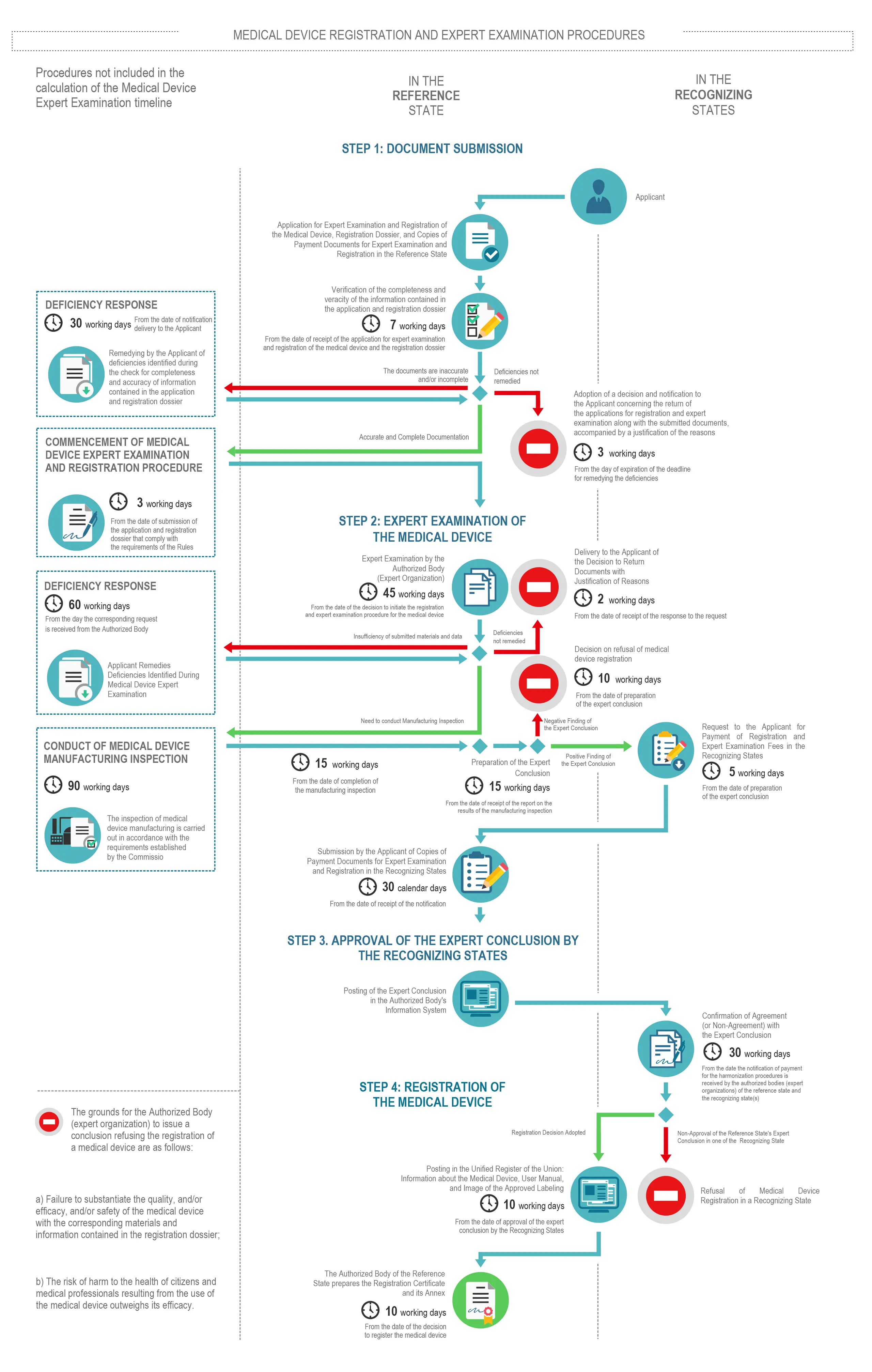
- Initial Document Collection & Analysis: Gathering and preliminary review of all technical and administrative documents provided by the manufacturer/AR, including risk class and nomenclature code determination
- Registration Dossier Preparation: Drafting missing documents and adapting submitted files to requirements
- Testing Strategy & Planning: Evaluation of required sample quantities and budgeting for all necessary tests (technical, toxicological, clinical)
- Lab & Clinical Site Selection: Identifying and contracting with accredited Russian test labs and clinical centers. Managing invoicing and agreements
- MD Samples: Manufacturing and/or import of medical device samples to the territory of the EAEU member state where testing will be conducted
- Testing Management & Oversight: Full coordination and supervision of all required laboratory tests and trials of device samples
- Reference State Selection: Selection of Reference Member State (RMS) and Recognizing Member States
- Dossier Submission & Fee Payment: Payment of state duties by the Applicant and submission of the completed registration dossier to the authorized body of the Reference Member State
- RMS Completeness Check: Verification of completeness and accuracy of submitted documentation and contained information by the authorized body (expert organization) of the Reference Member State
- Deficiency Response: Professional preparation and timely submission of responses to any queries or deficiencies identified by the RMS authority (if necessary)
- RMS Expert Assessment & Examination: Guiding the dossier through the expert assessment for quality, efficacy, and safety by the RMS expert institution
- Final Deficiency Response: Addressing any final remarks to secure a positive conclusion (if necessary)
- Production Site Audit Management: Organization and support during the mandatory Quality Management System (QMS) inspection of the manufacturing facility (if required by risk class)
- Recognition Procedure: Payment of recognition procedures for recognition of the RMS expert conclusion by Recognizing Member States, translation of documentation into languages of Recognizing Member States, submission of documents to Recognizing Member States
- Recognition Procedure: Recognition of the expert conclusion by authorized bodies (expert organizations) of Recognizing Member States
- Certificate Issuance: Issuance of the unified EAEU Registration Certificate
Official Duty for Medical Device Registration in EAEU (Russia as RMS) – Registration Certificate Issuance:
About $135 (applies to all risk classes)
Official Fees for Medical Device Registration in EAEU (Russia as RMS) – Dossier Expertise:
| Risk Class 1 |
about $885 |
| Risk Class 2a |
about $1 280 |
| Risk Class 2b |
about $1 670 |
| Risk Class 3 |
about $2 260 |
It is important to note that medical device registration in EAEU requires the payment of official fees in each Recognizing Member State where you intend to market your product.
Estimated Timelines for Medical Device Registration in EAEU:
| Risk Class 1 |
12-20 months |
| Risk Class 2a (non-sterile) |
12-20 months |
| Risk Class 2a (sterile, non-implantable) |
15-23 months |
| Risk Class 2a (sterile, implantable) |
31-39 months |
| Risk Class 2b |
31-39 months |
| Risk Class 3 |
31-39 months |
Our Service Fees for Medical Device Registration in EAEU:
| Risk Class 1 |
from $6 750 |
| Risk Class 2a (non-sterile) |
from $9 200 |
| Risk Class 2a (sterile) |
from $10 430 |
| Risk Class 2b |
from $12 270 |
| Risk Class 3 |
from $14 110 |
Core Regulatory Framework for Medical Device Registration in EAEU:
- EEC Council Decision No. 46 of February 12, 2016 “On the Rules for Registration and Expert Examination of Safety, Quality, and Efficacy of Medical Devices”;
- EEC Board Decision No. 173 of December 22, 2015 “On Approval of the Rules for Classification of Medical Devices Depending on the Potential Risk of Use”;
- EEC Council Decision No. 28 of February 12, 2016 “On Approval of the Rules for Conducting Technical Tests of Medical Devices”;
- EEC Council Decision No. 38 of May 16, 2016 “On Approval of the Rules for Conducting Studies (Tests) to Assess the Biological Effects of Medical Devices”;
- EEC Council Decision No. 42 of February 12, 2016 “On Approval of the List of Types of Medical Devices Subject to Classification as Measuring Instruments during Their Registration”;
- EEC Council Decision No. 98 of October 18, 2016 “On Approval of the Procedure for Type Approval of Measuring Instruments”;
- EEC Council Decision No. 29 of February 12, 2016 “On the Rules for Conducting Clinical and Clinical-Laboratory Trials (Studies) of Medical Devices”;
- EEC Board Recommendation No. 17 of September 4, 2017 “On the List of Standards Whose Voluntary Application, in Whole or in Part, Ensures Conformity of Medical Devices with the General Safety and Efficacy Requirements, Labelling Requirements, and Operational Documentation Requirements for Medical Devices”;
- EEC Board Recommendation No. 10 of June 8, 2021 “On Amending the List of Standards Whose Voluntary Application, in Whole or in Part, Ensures Conformity of Medical Devices with the General Safety and Efficacy Requirements, Labelling Requirements, and Operational Documentation Requirements for Medical Devices”;
- EEC Council Decision No. 106 of November 10, 2017 “On Requirements for the Implementation, Maintenance, and Evaluation of the Quality Management System of Medical Devices Depending on the Potential Risk of Their Use”;
- EEC Board Recommendation No. 27 of December 23, 2024 “On Methodological Recommendations for the Content and Structure of Medical Device Registration Dossier Documents and for Conducting Expert Examination of Safety, Quality, and Efficacy of a Medical Device for the Purpose of Its Registration within the EAEU”;
- EEC Board Recommendation No. 2 of February 11, 2025 “On Amending the List of Standards Whose Voluntary Application, in Whole or in Part, Ensures Conformity of Medical Devices with the General Safety and Efficacy Requirements, Labelling Requirements, and Operational Documentation Requirements for Medical Devices”;
- EEC Board Decision No. 18 of February 18, 2025 “On Amending the Rules for Classification of Medical Devices Depending on the Potential Risk of Use”;
- EEC Board Recommendation No. 20 of September 23, 2024 “On Methodological Recommendations for Classification of In Vitro Diagnostic Medical Devices Depending on the Potential Risk of Use for the Purpose of Their Registration within the EAEU”;
- EEC Board Decision No. 7 of January 26, 2024 “On Amending the Council of the Eurasian Economic Commission Decision No. 29 of February 12, 2016”;
- EEC Board Decision No. 174 of December 22, 2015 “On Approval of the Rules for Monitoring Safety, Quality, and Efficacy of Medical Devices”.



